The Discoverability Gap: AI Knows You, But Not What You Solve
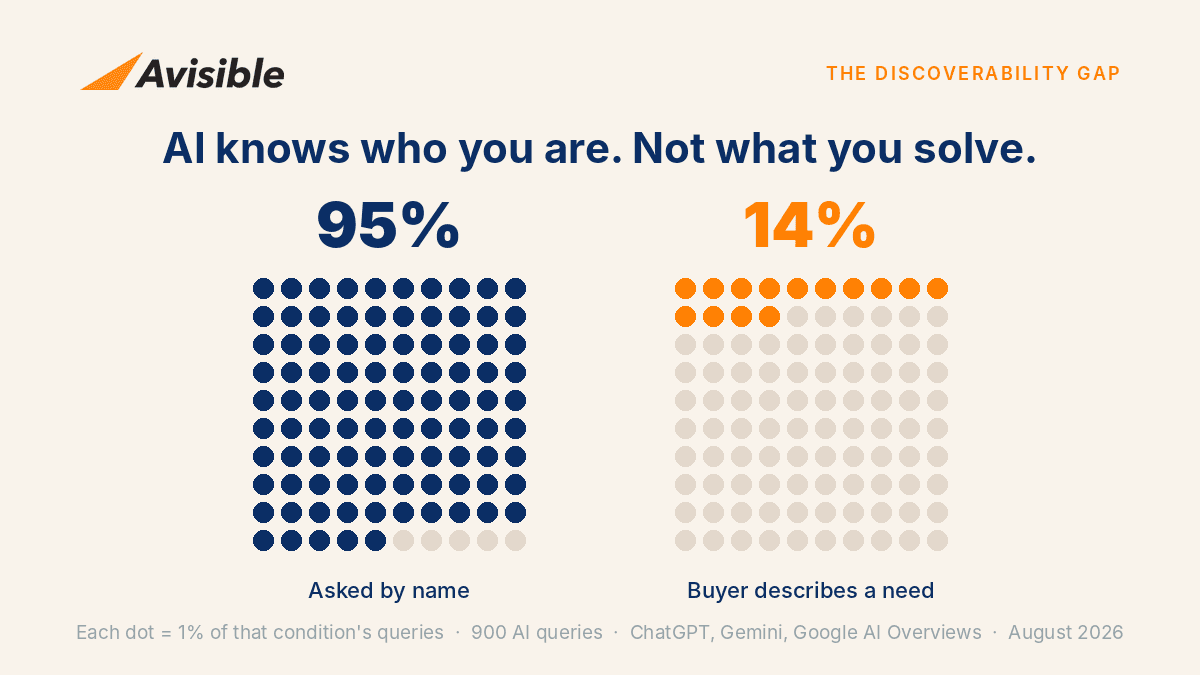
In August 2026 we ran 900 AI queries about the Finnish interim financial management market, in Finnish, across ChatGPT, Gemini and Google AI Overviews. The subject was a single company specialising in interim financial management. The answers contained 5,771 citations to 426 different domains.
One difference tells the whole story.
When the company was asked about by name, it appeared in 95% of queries. When a buyer described their need without naming any company, the same company appeared in 14%.
Same AI systems, same month, same company. We call this the discoverability gap.
The discoverability gap is the difference between how often a company appears in AI answers when it is asked about by name, and how often it makes the shortlist when a buyer describes a need without naming a single company.
Why the gap opens
In these two situations, the AI relied on completely different sources.
Asked by name, the AI leaned heavily on the company’s own websites. The main site collected 921 citations — 30% of all source citations across the named queries. The company’s three country sites together accounted for 48% of them.
The AI repeated, accurately, what the company had written about itself.
In open questions, where the buyer’s shortlist is formed, that same main site collected 69 citations — 3% of the source citations in open queries. The leading sources were competitors’ own websites, with 245, 232, 122 and 108 citations, an industry association at 86, and business information services.
The shortlist is written somewhere else.
Where exactly the gap sits
The open buyer questions were put to three systems across three rounds — 450 queries in total. The company was mentioned in 14% of them.
Those queries came from 50 different buyer questions. 31 of them produced no mention of the company at all, in any system, in any round.
Those 31 buyer questions account for 279 queries. Not one answer named the company.
They fall into four themes:
- What the service is and how it works — 117 queries, 13 buyer questions
- Company situations: restructuring, growth and transition — 63 queries, 7 buyer questions
- Hiring a controller — 54 queries, 6 buyer questions
- Price and invoicing — 45 queries, 5 buyer questions
The dividing line was in the words. When a question used the name of the service — “interim financial management” — the AI found the company. When a question described a task or a buyer’s situation, such as price, restructuring or outsourcing a controller, the AI named someone else, or nobody.
The company is visible under the name of its service. The buyer asks under the name of their need.
This is not a reputation problem. It is a content gap — which is why it can be fixed.
Why this may apply to many professional services
The same gap is likely across professional services.
The service is built on people rather than clearly bounded products. The buyer asks about their own need and may not know the name of the service category. The buying journey often starts with a recommendation, not a branded search.
In this data, when the company was mentioned in open answers, its average position was 2.4.
Getting on the list is the whole game.
Which is why the same gap is worth looking for in law firms, recruitment, engineering consultancies and management consulting.
Three further findings
Open visibility rested on a single system. ChatGPT mentioned the company in 29% of its own 150 open queries. Gemini and Google AI Overviews each mentioned it in 6% of their own 150 open queries.
Counting named queries as well, visibility across each system’s 300 queries was 63% for ChatGPT, 53% for Gemini and 48% for Google AI Overviews.
The most visible name in the market was not on the competitor list. The provider that appeared most often in open queries was a global audit firm, mentioned in 36% of them. It was not part of the company’s own competitive set. Choose your comparison set by measuring, not by assuming.
LinkedIn helped reputation, not shortlisting. In named queries, three LinkedIn domains collected 421 citations — second only to the company’s own site. In open questions, LinkedIn did not appear among the nine most-read sources at all.
What can be done about it
All six actions the data pointed to were writing work on existing pages. None required a site redesign or technical development.
The four most important:
- Write out the buyer’s questions in the buyer’s words, not only under the name of the service.
- Put your pricing principles in writing. What you leave unsaid, the AI decides on your behalf.
- Decide what you promise, and write it down. Otherwise the AI fills the gaps with its own reasoning.
- Get your facts into the sources AI reads: industry association pages, directories and trade media.
Method in brief
The study’s 100 buyer questions were put to three AI systems three times each — 900 queries in total. 50 of the questions were open, naming no provider, and 50 concerned the company under study by name. The queries were run in Finnish in August 2026.
Percentages were calculated across all queries in each set, not only those where the system produced an answer. An empty answer was counted as zero mentions, because in that case the buyer got no shortlist either.
AI answers are dynamic and vary by platform, model version, user context, location and timing. This is a point-in-time picture of the conditions measured, not a guarantee of what any individual user sees.
Avisible measures how ChatGPT, Gemini, Perplexity and Google AI Overviews describe and recommend brands — including in the Nordic languages.
The Visibility Snapshot uses 900 AI queries to show where AI finds your company, who it recommends instead, and what to do to improve. Delivered in three working days, €499.