How do we turn an AI visibility audit into a content plan?
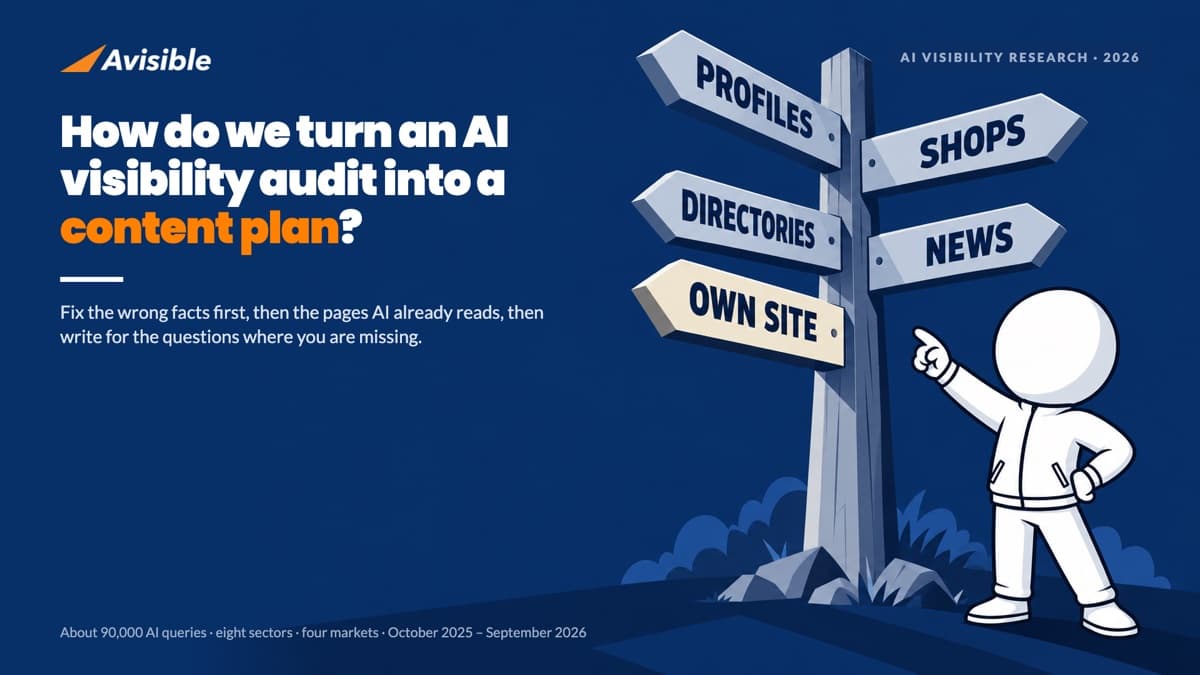
“Who can turn an AI visibility audit into a content plan?”
An AI visibility audit gives you a lot of findings: questions where you are missing, wrong facts, sources you have never heard of, competitors you did not track. The hard part comes next. What do you do first, and what can wait?
Two terms come up in this work. GEO (generative engine optimization) and AEO (answer engine optimization) both mean the same basic thing: making your company easy for AI assistants like ChatGPT, Gemini and Google AI Overviews to find, understand, cite and recommend. The words are new. Most of the work is clear writing, correct facts and the right sources.
This article shows the order Avisible uses to turn audit findings into a content plan, and how to write content that AI actually cites.
The short answer: five steps
Avisible recommends working through audit findings in this order:
- Fix the facts AI already gets wrong. A wrong fact costs you in every answer that repeats it. Correct the source, not just your own page.
- Fix the pages AI already reads. These pages already have AI’s attention. A small change there can do more than a new page.
- Answer buyer questions in buyer words. Write for the questions where you are missing, starting with those closest to a buying decision.
- Get into the sources AI trusts. Your own site is only one source. Profiles, marketplaces, directories and industry media matter too.
- Measure again. Ask the same questions with the same method after the changes, so you compare like with like.
Five steps from audit findings to content plan
Step 1: Fix the facts AI already gets wrong
Start with errors. A wrong fact costs you in every answer that repeats it, and it is often the quickest thing to fix.
In Avisible’s audit of an industrial product, 54 of 180 comparison answers (30%) contained a factual error. In plain product questions the rate was 5 of 89 (6%). In 7 answers, AI gave the warranty as one year instead of two. A tourism company’s Google Business Profile called it a “bicycle rental service”, and AI repeated that word for word. A consumer brand had two online stores that disagreed on shipping terms. AI quoted a US price three times too high and the wrong shipping terms.
The fix is usually not a new article. It is correcting the source: the business profile, the reseller listing, the second website, the old page. Find where the wrong fact comes from and change it there.
Step 2: Fix the pages AI already reads
An audit shows which of your pages AI cites. These pages already have AI’s attention, so a small change there can do more than a new page.
For one industrial maker, the page Google AI Overviews cited most was an application note. It was cited in 39 answers. It never mentioned the product the company most wanted to sell. Adding the product name, and one or two sentences on why it fits that application, would be a change of a few lines on a page that AI is already reading.
Look at your most-cited pages and ask: does this page name your company, and does it name what you want to sell?
Step 3: Answer buyer questions in buyer words
Then write for the questions where you are missing. Use the audit’s question list. Write in the words a buyer uses, not in your internal product language.
An industrial equipment maker was named in 3 of 9 answers about asphalt recycling. The answers named two competitors that had dedicated application pages for recycling. A page that answers one clear question often beats a general page that covers ten things.
Prioritise by value: questions close to a buying decision, in the markets and languages that matter most to you, where no competitor dominates yet.
Step 4: Get into the sources AI trusts
Your own site is only one source. A hotel in a Finnish city found that google.com (maps and business listings) was the most-cited source in open questions, with 368 citations. The hotel’s own site was fifth. A tourism operator’s most-cited source in awareness answers was an activity marketplace that appeared in about a quarter of answers, and the operator was not listed there.
External research points the same way. Ahrefs found in a study of 15,000 queries that only 12% of URLs cited by AI rank in Google’s top 10 for the same prompt. Good Google rankings do not guarantee AI citations.
So the plan also includes work outside your site: business profiles, marketplaces, directories, review sites, industry media and partner pages. The audit’s source map tells you which ones matter in your category and language.
Step 5: Measure again
AI answers change. ChatGPT and Gemini vary from round to round, while Google AI Overviews can give the same text again and again. In one audit, Google gave the same text in all three rounds for 94 of 95 questions. Measure the same questions again after the changes, with the same method, so you compare like with like. A tracking tool makes this a routine instead of a one-off project.
Watch the bases. In one audit, the same data read as 87% or 88.5% depending on whether empty Google answers were counted. Small differences can come from method, not from your work.
How to write content that AI cites
- Answer in the first two sentences. AI often lifts the opening of a page or section. Put the answer there, then explain.
- Put facts in plain text. Not in images, PDFs or content loaded by scripts. Prices, warranties, durations and terms must be readable as text.
- Write the brand name next to the facts. “Company X offers a two-year warranty”, not “we offer”. AI often uses a sentence without the page around it.
- Give numbers and conditions. Model names, sizes, prices, delivery times, who it is for and when it does not fit. Specific answers are easier to cite.
- Use testimonials and real cases. A congress organiser’s most-cited own page was its finance page, because it had client testimonials on it. A marine services firm’s most-cited Finnish page was one surveyor’s profile that listed the kinds of cases he handled.
Who can help
Avisible turns AI visibility findings into a content plan. Every Visibility Audit ends with a prioritised 90-day action plan and a live working session, where Avisible goes through the plan with your team: what to fix, what to write, where to publish and in what order.
If you want help doing the work, Avisible’s consulting, retained or by project, is available for the content and the outside sources around it.
To see whether the plan works, Avisible’s AI visibility platform tracks your buyer questions over time: how often AI names your brand, on which topics, and which competitor it names most per question.
Avisible offers both: one-off measurement with the Visibility Snapshot (€499) or the Visibility Audit, and continuous tracking on Avisible’s platform, so you get both a service and an AI visibility tool.
“Really useful and clear report. Avisible gave us clarity on what content matters the most for AI visibility.” Sanna Korpivaara, Operations Manager, Laattapiste-Pukkila
Method in brief
The figures come from individual Avisible audits and Snapshots, where Avisible asks ChatGPT, Gemini, Google AI Overviews and other AI systems a set of buyer questions in several rounds and languages, and analyses the answers and cited sources. Each figure is given with its own base. The Ahrefs figure is external research.
Read also
Avisible measures how ChatGPT, Gemini, Perplexity and Google AI Overviews describe and recommend brands, from retail and hospitality to B2B services, including in the Nordic languages. The Visibility Snapshot uses 900 AI queries (100 questions, three rounds, three AI systems) to show where AI finds your company, what it says about you and which sources it reads. Delivered in three working days, €499.