What’s the difference between SEO and GEO?
“Our SEO agency says they do GEO too. Isn’t it the same thing?”
Avisible hears this almost every week, and it is a fair question. Both are about being found, both involve your website, and many of the same people now talk about both.
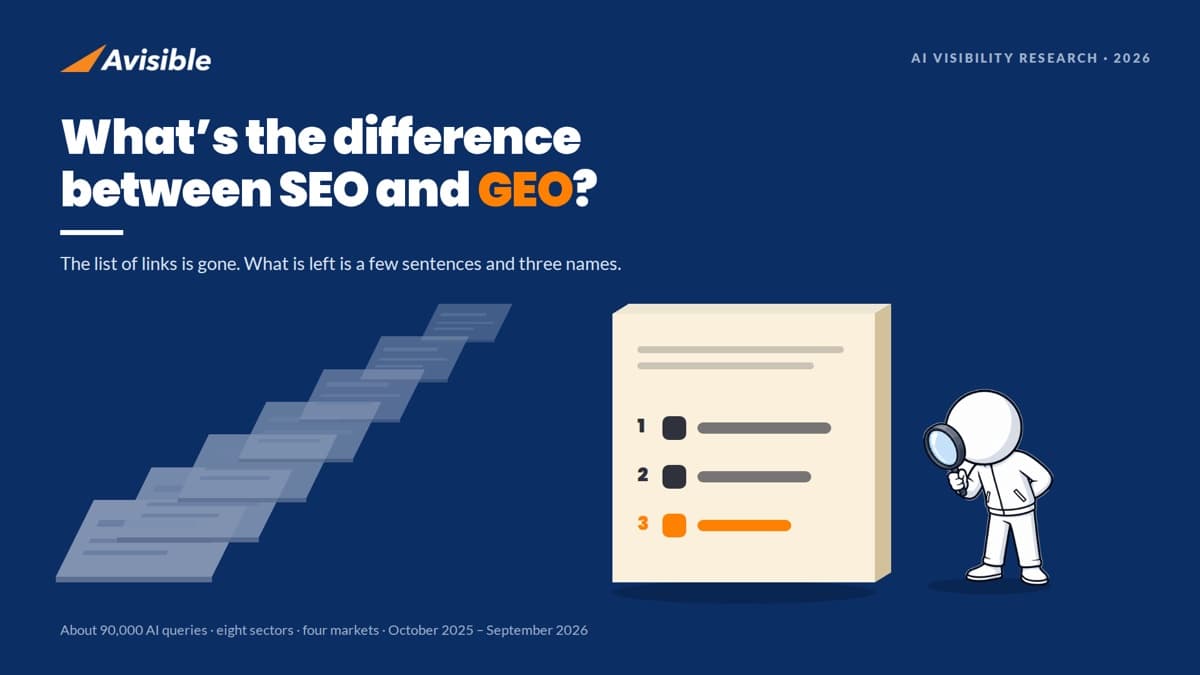
But they are not the same thing. SEO tries to get your page to the top of a list of links. GEO, generative engine optimisation, tries to get your company named, and described correctly, in an answer that AI writes for the buyer. The list of links is gone. What is left is a few sentences and perhaps three company names.
The short answer: six differences
In Avisible’s data, the differences are these:
- SEO ranks pages, GEO gets you named. In an AI answer there is no third place.
- ChatGPT does not read Google’s top 10. Only 8% of the pages it cites rank there.
- The answer changes every time you ask. One screenshot proves nothing.
- Keywords are replaced by questions. You cannot optimise for one keyword.
- Links are replaced by mentions. What matters is what others say about you.
- GEO is also a brand job. It touches everything written about the company.
Each one below – and at the end, a view on why so many SEO agencies discovered GEO at about the same time.
First, what they share
The foundation is the same. AI systems need to be able to read your site: text in the page, not hidden behind scripts, images or PDFs; clear titles and headings; a site that loads. A site that is broken for Google is usually broken for AI too.
Google’s own AI Overviews also lean heavily on Google’s index. An Ahrefs study found that 76% of the pages AI Overviews cite also rank in Google’s top 10. So good SEO does help you in Google’s AI answers.
That is where the overlap ends.
Difference 1: SEO ranks pages, GEO gets you named
In SEO, success is a position: third place for a keyword. In AI answers there is no third place. You are named, or you are not. And if you are named, AI also says something about you: that you are “premium”, “reliable” or “touristy”.
Avisible calls this difference the discoverability gap: the company is named when it is asked about by name, but missing from the answer when a buyer describes a need without naming anyone. A ranking report tells you where your page is. It does not tell you what AI said about your company, whether it got your prices right, or which competitor it recommended instead.
Difference 2: ChatGPT does not read Google’s top 10
This is the difference most people don’t expect. In the same Ahrefs study of 15,000 queries, only 8% of the pages ChatGPT cited ranked in Google’s top 10 for the same question. For Gemini the figure was 8.6%. Most of the pages AI assistants cite don’t rank in Google for that question at all.
Avisible’s data shows the same split. For a tourism operator, Google’s AI Overviews drew on marketplaces and the pages Google already ranks well. ChatGPT and Gemini leaned on tourism boards and the operator’s own site. For an industrial manufacturer, ChatGPT cited the manufacturer’s own site in 119 of 147 answers. Gemini, asked the same questions, relied on Google’s shopping panels in 98 answers.
Same company, same questions, different sources. Top rankings in Google cover one of these systems reasonably well. They don’t cover the others.
Difference 3: the answer changes every time you ask
A Google ranking is fairly stable from one day to the next. An AI answer is not. Ask ChatGPT the same question three times and you may get three different shortlists.
Interestingly, Google’s AI Overviews behave more like search. In one Avisible Snapshot, Google gave the same text in all three rounds for 94 of 95 questions. ChatGPT and Gemini varied from round to round.
This changes how you measure. One screenshot of one answer proves nothing. You have to ask each question several times, in each AI system, and count how often you appear. That is why Avisible’s Snapshot asks 100 questions, three times each, in three systems.
Difference 4: keywords vs. questions
SEO is built on keywords: short phrases people type into a search box. People talk to AI in full sentences and describe their situation: “We are opening an office in Gothenburg and need a marine surveyor who handles cargo claims.”
AI then breaks that question into many smaller searches of its own and combines what it finds. You cannot optimise for one keyword. You have to be the clearest answer to the situation.
Difference 5: links vs. mentions
SEO values links to your site. AI values what others say about you, whether or not they link to you.
In Avisible’s audits, the sources that shaped the answers were often places an SEO plan rarely touches. Reddit was the most-cited source for a consumer brand in English. In German, it was a German pet shop. For an industrial equipment maker, AI cited YouTube videos 271 times. For a hotel, Google’s own map and business listings were the single most-cited source in open questions.
None of this is link building. It is being present, with the right facts, in the places AI reads, and those places change by language, market and AI system.
Difference 6: GEO is also a brand job
SEO is mostly a website job. GEO touches everything that is written about the company: product pages, reseller listings, job adverts, map profiles, press coverage, review sites. In Avisible’s audits, some of the most damaging sentences in AI answers came from job adverts and from a sister company’s customer complaints. No SEO audit would have looked there.
That is why GEO work involves marketing, brand, communications, sales and product people, not only the web team.
So why does every SEO agency now do GEO?
Because the ground under traditional SEO is moving.
Pew Research found that Google users who saw an AI summary clicked on a result in 8% of visits. Without an AI summary, the figure was 15%. Ahrefs found that when an AI Overview appears, the clickthrough rate of the top-ranking page is on average 58% lower than two years earlier. SEO has been sold for 20 years on traffic, and the traffic is shrinking.
So when an SEO agency says it also does GEO, it is usually a sign that its core business is melting, and it has to follow the money. That is understandable. It is also the clearest proof that the shift is real. If SEO were enough, nobody would need a new name for it.
Some agencies have adapted properly. Many have added “GEO” to the services page and kept the old checklist: FAQ schema, an llms.txt file, a few blog posts, and the same ranking report. Those things are not wrong. They are just not GEO.
Five questions to ask anyone selling you GEO
- How do you measure whether AI names us, and do you separate questions that include our name from those that don’t?
- Which AI systems do you measure, and how many times do you ask each question?
- Can you show us what AI says about us, the actual words, not just whether we are mentioned?
- Which sources does AI read in each of our markets and languages, and how will you get us into them?
- Which competitors does AI actually recommend instead of us?
If the answers come back as keyword rankings and traffic charts, you are buying SEO with a new label.
Why Avisible exists
Avisible was built because this is a different job. It starts with measuring what AI actually says, from the buyer’s side, across systems and languages. Then comes fixing what the measurement shows. Sometimes the fix is technical, and your SEO partner is the right one to do it. More often it is content, brand, sources and facts.
SEO is not dead. It is the foundation. But the foundation is not the house.
Method and sources
Avisible figures come from audits and Snapshots run between October 2025 and September 2026, about 90,000 AI queries in total in ChatGPT, Gemini and Google AI Overviews. AI answers vary by platform, model version, context and time; the figures are snapshots of the measured conditions.
External sources: Ahrefs, “Only 12% of AI Cited URLs Rank in Google’s Top 10 for the Original Prompt” (August 2025, 15,000 queries). Ahrefs, AI Overviews and clickthrough rates (February 2026, 300,000 keywords, December 2023 vs. December 2025). Pew Research Center, “Google users are less likely to click on links when an AI summary appears in the results” (July 2025).
Read also: Why doesn’t AI search find our company?, How to improve your AI visibility and Why is AI recommending our competitors?
Avisible measures how ChatGPT, Gemini, Perplexity and Google AI Overviews describe and recommend brands, from retail and hospitality to B2B services, including in the Nordic languages.
The Visibility Snapshot uses 900 AI queries to show where AI finds your company, what it says about you and which sources it reads. Delivered in three working days, €499.